AI Prompt Engineering Tools 2026: Top Prompt Managers, Optimizers, and Testing Platforms Compared
Prompt engineering has evolved from an experimental skill practiced by early ChatGPT adopters into a systematic discipline that drives real business outcomes. In 2026, organizations that invest in prompt engineering tooling consistently achieve 3-5x higher quality outputs, reduce API costs by up to 40%, and ship AI-powered features significantly faster than those relying on ad-hoc prompting. The ecosystem of tools supporting this discipline has matured rapidly, giving practitioners everything from simple template libraries to sophisticated multi-model testing frameworks with built-in observability.
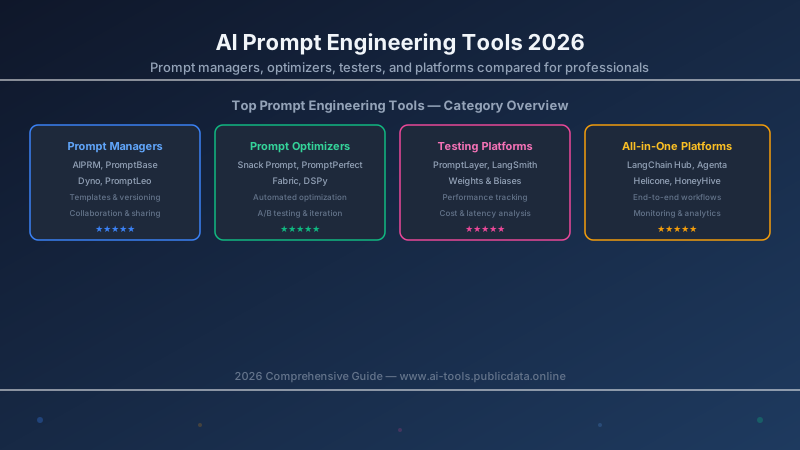
This guide provides a comprehensive overview of the best AI prompt engineering tools available in 2026, organized into four categories: prompt managers for organization and collaboration, prompt optimizers for automated refinement, testing and evaluation platforms for quality assurance, and all-in-one platforms that combine these capabilities into unified workflows. Whether you are an individual developer or part of a large AI team, the right tooling can transform prompt engineering from guesswork into a repeatable, measurable practice.
The State of Prompt Engineering in 2026
Prompt engineering has undergone a fundamental transformation over the past two years. What was once primarily about crafting clever instructions for chat-based LLMs has expanded into a multi-faceted discipline that encompasses prompt versioning, automated optimization, regression testing, cost tracking, and multi-model orchestration. Three key trends define the current landscape.
First, structured prompt frameworks have become the norm. Instead of free-form text, modern prompts use YAML, JSON, or custom DSLs that separate instructions, context, examples, output format specifications, and guardrails into distinct fields. This structured approach enables automated validation, version control with meaningful diffs, and programmatic generation of prompt variants for A/B testing. Tools like DSPy have pioneered programmatic prompt optimization, treating prompts as parameters to be learned rather than text to be hand-crafted.
Second, observability and evaluation have become critical infrastructure. Teams now track prompt performance metrics including output quality scores, latency percentiles, token consumption, cost per request, and failure modes — all correlated with specific prompt versions and model configurations. Platforms like LangSmith and PromptLayer have built sophisticated dashboards that give teams visibility into how their prompts perform across millions of requests, enabling data-driven iteration rather than intuition-based tweaking.
Third, multi-model prompt management has emerged as a major requirement. Organizations rarely commit to a single LLM provider; instead, they route requests across models based on task complexity, latency requirements, cost constraints, and regional availability. Managing prompts that work well across GPT-5, Claude 4, Gemini 2.0, DeepSeek-V3, and open-source models requires tooling that supports model-specific prompt variants, automated compatibility testing, and fallback strategies when a particular model underperforms on a given prompt.
Best Prompt Management Tools for Organization and Collaboration
Prompt managers solve the foundational problem of keeping track of prompt versions, organizing them by project and use case, and enabling team collaboration. As companies scale their AI initiatives from a handful of prompts to hundreds or thousands, spreadsheets and shared documents become unmanageable. Dedicated prompt management platforms provide the structure needed for professional prompt engineering.
AIPRM — The Browser-Based Prompt Library
AIPRM remains the most widely used prompt management tool in 2026, particularly for individuals and small teams. Originally launched as a Chrome extension for ChatGPT, AIPRM has evolved into a full-featured platform supporting Claude, Gemini, and custom API endpoints. Its library contains over 5,000 community-contributed prompt templates across categories including marketing, coding, writing, research, and customer support. AIPRM's key strength is accessibility — users can install the extension and start using curated prompts in minutes without any setup. The platform now includes prompt versioning, basic A/B testing, and a team workspace feature that allows groups to share and manage prompt collections. Pricing starts at free for basic access, with Pro at $9/month and Team at $29/user/month offering advanced analytics, custom categories, and priority support.
PromptBase — The Marketplace for Professional Prompts
PromptBase has established itself as the leading marketplace for buying and selling professionally crafted prompts, with over 50,000 verified prompts available for DALL-E 3, Midjourney, Stable Diffusion, ChatGPT, Claude, and dozens of other AI models. What sets PromptBase apart is its rigorous quality control: every prompt submitted undergoes manual review for effectiveness, clarity, and originality. In 2026, PromptBase expanded beyond one-off prompt sales to offer prompt subscriptions — monthly bundles of curated prompts for specific use cases like e-commerce product descriptions, SEO content generation, and code documentation. For prompt engineers selling their work, PromptBase provides analytics on prompt performance and customer feedback. Pricing ranges from $1.99 per individual prompt to $29/month for subscription bundles.
Dyno and PromptLeo — Enterprise Prompt Governance
For larger organizations that need strict governance, audit trails, and role-based access control, enterprise-focused tools like Dyno and PromptLeo have gained significant adoption in 2026. Dyno provides a centralized prompt management platform with features including prompt approval workflows, automated compliance checks (GDPR, SOC 2, HIPAA), and integration with major LLM providers for direct deployment. PromptLeo specializes in prompt security, offering prompt injection detection, PII redaction before prompts reach external APIs, and detailed audit logs showing who modified which prompt and when. Both platforms support API-first architectures, making them suitable for teams that manage prompts programmatically as part of their CI/CD pipelines. Enterprise pricing for both typically ranges from $500 to $2,000 per month depending on team size and feature requirements.
Prompt Optimization Tools: Automating the Refinement Process
Manual prompt optimization — writing a prompt, testing it, tweaking it, testing again — is time-consuming and often produces suboptimal results. Prompt optimization tools automate this process using techniques including few-shot example selection, instruction rephrasing, chain-of-thought structuring, and hyperparameter tuning. These tools can evaluate hundreds of prompt variants automatically and identify the best performers based on customizable quality metrics.
Snack Prompt — AI-Guided Prompt Improvement
Snack Prompt has emerged as a leading tool for automated prompt optimization, leveraging AI to analyze and improve prompts. Users submit a base prompt along with a few examples of desired outputs, and Snack Prompt's optimization engine generates multiple refined variants ranked by predicted effectiveness. The tool uses a proprietary evaluation model trained on millions of prompt-output pairs to score prompts across dimensions including clarity, specificity, instruction completeness, and expected output quality. Snack Prompt also supports multi-model optimization — optimizing a prompt to work well across GPT-5, Claude 4, and Gemini 2.0 simultaneously. The service offers a free tier (10 optimizations per month), Pro at $15/month for 200 optimizations, and unlimited Enterprise plans starting at $99/month.
PromptPerfect — Comprehensive Prompt Engineering Studio
PromptPerfect by Jina AI has positioned itself as the most comprehensive prompt optimization platform, supporting text, image, and code generation models. Its optimization engine offers multiple strategies including instruction refinement, role-prompting enhancement, few-shot example optimization, and output format specification. PromptPerfect's standout feature is its cross-model compatibility testing: it can automatically evaluate how a prompt performs across different models and identify which model produces the best results for a given task. The platform also includes a prompt comparison tool that visualizes differences between prompt versions and their corresponding outputs, making it easy to understand what changes drive improvements. Pricing starts at $19/month for the Pro plan with 500 optimization credits, with Team plans at $49/user/month.
DSPy — Programmatic Prompt Optimization for Developers
For teams comfortable with Python, DSPy (Declarative Self-improving Python) has become the gold standard for programmatic prompt optimization. Rather than treating prompts as text strings, DSPy treats them as parameterized modules in a declarative programming framework. Developers define the structure of their AI pipeline using DSPy's modules — signatures, chain-of-thought, ReAct, or custom modules — and the framework automatically optimizes the underlying prompts for each component using techniques like few-shot bootstrap, random search, and Bayesian optimization. DSPy's key advantage is that it produces consistently high-quality results without manual prompt tweaking, and optimized prompts are automatically portable across models. DSPy is open-source (Apache 2.0) and free to use, with cloud-hosted optimization services available through the DSPy Cloud platform starting at $49/month.
Prompt Testing and Evaluation Platforms
Testing is arguably the most important yet most overlooked aspect of prompt engineering. Without systematic evaluation, teams have no way to know whether a prompt change actually improves output quality, degrades performance for certain inputs, or introduces subtle regressions. Modern testing platforms provide the infrastructure needed to run rigorous evaluations at scale.
PromptLayer — The First Prompt Observability Platform
PromptLayer was one of the earliest entrants in the prompt observability space and remains one of the most mature platforms in 2026. It provides end-to-end logging and analytics for LLM requests, automatically capturing every prompt sent to supported models along with the response, latency, token count, cost, and metadata. PromptLayer's evaluation framework allows teams to score responses using either automated metrics (exact match, semantic similarity, regex validation) or human-labeled evaluations. The platform supports regression testing — teams can define a test suite of inputs and expected outputs, then run it against any prompt version to catch regressions before deployment. PromptLayer integrates with all major LLM providers and frameworks including LangChain, LlamaIndex, and custom API clients. Pricing starts at free for 10,000 requests/month, Growth at $99/month for 100,000 requests, and Enterprise with custom pricing for higher volumes.
LangSmith — LangChain's Full-Lifecycle Platform
LangSmith, developed by the creators of LangChain, provides a comprehensive platform covering the entire prompt engineering lifecycle from development through testing, deployment, and monitoring. Its evaluation capabilities are particularly strong: teams can define datasets of test cases, run evaluations across multiple prompt variants and models simultaneously, and visualize results in detailed comparison reports. LangSmith's tracing feature captures every step of an LLM call chain, making it invaluable for debugging complex multi-step prompt pipelines. The platform automatically detects performance regressions, drift in output quality over time, and unusual patterns in error rates or latency. LangSmith offers a free tier for individual developers (5,000 traced requests/month), Team at $99/month, and Enterprise with volume-based pricing for organizations handling extensive AI workloads.
Weights & Biases — ML-First Prompt Evaluation
Weights & Biases (W&B), long established as a leading MLOps platform, has expanded into prompt engineering with its Prompts product. W&B's approach leverages its deep experience with experiment tracking and model evaluation, applying similar rigor to prompt development. Teams can log prompt experiments, track metrics across runs, visualize prompt performance in customizable dashboards, and compare different optimization strategies side by side. W&B's strength is its integration with existing ML workflows — teams already using W&B for model training can extend the same infrastructure to prompt engineering, creating a unified view of their AI pipeline from model development through prompt optimization. W&B is free for personal use, with Team plans at $50/user/month and Enterprise pricing available for organizations with advanced compliance and collaboration needs.
All-in-One Prompt Engineering Platforms
For teams that want a unified solution covering prompt management, optimization, testing, and monitoring, several all-in-one platforms have emerged that combine these capabilities into a single integrated experience.
LangChain Hub — The Open Prompt Registry
LangChain Hub serves as a centralized registry for sharing, discovering, and versioning prompts within the LangChain ecosystem. It functions as a combination of a prompt library, collaboration platform, and deployment registry. Teams can publish prompts as reusable components, tag them with metadata, and consume them across their LangChain applications. Hub supports structured prompt formats with input schemas, output parsers, and model-specific instructions. In 2026, Hub has become the default prompt management solution for teams already invested in LangChain, with many organizations adopting it as their internal prompt registry for governance and reuse. Hub is free for public prompts, with Team Hub at $49/month for private registries with role-based access control.
Agenta — Open-Source LLM Evaluation Platform
Agenta has gained significant traction as an open-source alternative for teams that want full control over their prompt evaluation infrastructure. It provides a web-based interface for managing prompt variants, defining test datasets, running evaluations across multiple models, and analyzing results. Agenta's evaluation framework supports both automated metrics and human evaluation workflows with built-in annotation tools. The platform is self-hostable, making it suitable for organizations with strict data residency requirements or those operating in air-gapped environments. Agenta is open-source under Apache 2.0 license, with Agenta Cloud starting at $99/month for managed hosting with additional storage and compute resources.
Choosing the Right Prompt Engineering Tool Stack in 2026
The best prompt engineering tool stack depends on your team's size, technical sophistication, and specific requirements. Here is our recommendation framework for different scenarios:
Individual developers and freelancers: Start with AIPRM for prompt organization and Snack Prompt for optimization. Both have free tiers and require minimal setup. Add PromptLayer's free tier for basic request logging and testing. Total cost: $0-15/month.
Small teams (2-10 people): Use AIPRM Team for prompt management and collaboration, PromptPerfect for optimization with its cross-model testing, and LangSmith for evaluation and monitoring. This stack covers the full workflow at approximately $150-300/month total for the team.
Mid-size organizations (10-50 people): Consider Dyno or PromptLeo for enterprise-grade prompt governance, DSPy for programmatic optimization integrated into your CI/CD pipeline, and LangSmith or W&B for comprehensive evaluation and monitoring. Implement PromptLayer for request-level observability. Budget: $500-2,000/month.
Large enterprises (50+ people): Deploy a multi-layered stack with LangChain Hub or Agenta for internal prompt registry and governance, DSPy for automated optimization, LangSmith Enterprise for evaluation and monitoring, and PromptLeo for security and compliance. Integrate prompt testing into your existing ML evaluation infrastructure. Enterprise pricing varies significantly based on volume and requirements.
The key insight for 2026 is that prompt engineering tooling should be chosen not in isolation but as part of a broader AI development infrastructure. The best tools integrate with each other and with your existing development workflows, creating a seamless pipeline from prompt creation through optimization, testing, deployment, and monitoring. As AI capabilities continue to advance, the teams that invest in professional prompt engineering infrastructure will maintain a significant competitive advantage in delivering reliable, high-quality AI-powered features to their users.
📖 推荐阅读
Best AI Code Generation Tools 2026: DeepSeek Coder V3, Claude 4, Copilot, and Cursor Compared
Comprehensive comparison of DeepSeek Coder V3, Claude 4, GitHub Copilot, and Cursor
AI Video Generation Tools 2026: Sora, Runway Gen-4, Pika 2.0, and Kling Compared
Comprehensive comparison of Sora, Runway Gen-4, Pika 2.0, and Kling
AI Meeting Assistant Tools 2026: Otter, Fireflies, Fathom, and Read Compared
Detailed comparison of top AI meeting assistant tools in 2026
2026年多模态AI工具全面对比:GPT-5、Claude 4、Gemini 2.0谁更强
深度评测2026年三大多模态AI平台的能力、价格和应用场景