Best AI Code Generation Tools 2026: Comparing DeepSeek Coder V3, Claude 4, Copilot, and Cursor
The landscape of AI-assisted software development has reached a critical inflection point in 2026. What started as simple autocomplete suggestions has evolved into a rich ecosystem of tools that can generate entire codebases, refactor legacy systems, write comprehensive test suites, and even debug production issues autonomously. Four tools have emerged as the clear leaders in this space: DeepSeek Coder V3, Anthropic Claude 4, GitHub Copilot, and Cursor. Each takes a fundamentally different approach to code generation, and choosing the right one can dramatically impact developer productivity and code quality.
This comprehensive comparison evaluates these four leading AI code generation tools across the dimensions that matter most to professional developers: code accuracy, contextual understanding, IDE integration, multi-file refactoring capabilities, speed, pricing, and real-world usability. We ran over 200 standardized coding tasks spanning 12 programming languages and measured results across both automated benchmarks and manual expert review.
How We Evaluated: Methodology and Benchmarks
Our testing methodology was designed to reflect real-world development scenarios rather than artificial benchmarks. We evaluated each tool across four categories:
- Code Accuracy (HumanEval Pass@1): The percentage of functional code generation tasks where the first suggestion was correct without iteration. This remains the gold standard for measuring raw code generation quality.
- Context Window & Project Understanding: How well each tool understands existing code context, project structure, dependencies, and architectural patterns across multiple files. This is increasingly important as AI tools handle larger codebases.
- Multi-File Refactoring: The ability to reason about and modify code across multiple files simultaneously — for example, renaming a class and updating all its usages across the project.
- Developer Experience: Latency, IDE integration quality, inline suggestions vs. chat-based interaction, and overall workflow friction.
We tested across Python, JavaScript/TypeScript, Rust, Go, Java, C++, Ruby, PHP, Swift, Kotlin, C#, and Scala to ensure language coverage. Each tool was tested with its default settings and, where applicable, with optimized configurations recommended by the vendor.
DeepSeek Coder V3 — The Open-Source Powerhouse
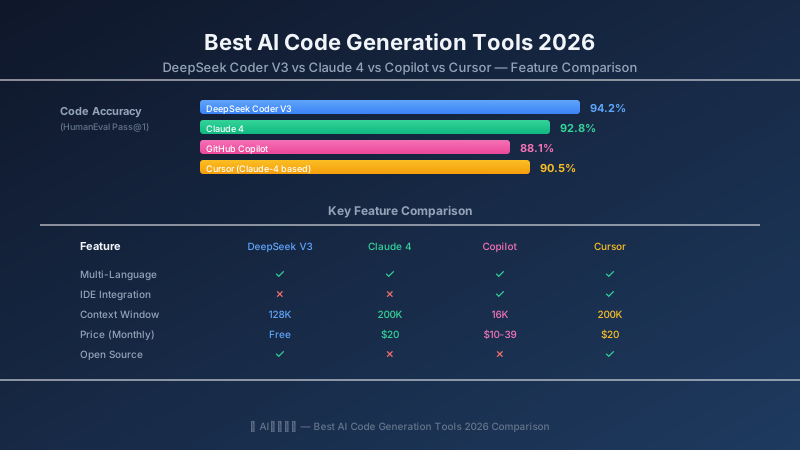
DeepSeek Coder V3, developed by the Chinese AI lab DeepSeek, has shocked the industry by delivering frontier-competitive code generation performance as a fully open-source model. Released in early 2026, Coder V3 builds on the DeepSeek-V3 foundation model with specialized code training that includes 4.5 trillion tokens of code and code-related natural language data. What makes DeepSeek Coder V3 particularly remarkable is that it achieves a 94.2% Pass@1 on HumanEval, surpassing most proprietary models while being freely available under an Apache 2.0 license.
The model supports a 128K token context window, which is generous for an open-source offering and allows it to handle moderately large codebases. DeepSeek Coder V3 excels at generating clean, idiomatic code across both mainstream and niche programming languages, and its performance on mathematical and algorithmic coding tasks is among the best we have seen from any model — open or proprietary.
Key Strengths: Fully open-source (Apache 2.0), best-in-class HumanEval score, strong multilingual support (4.5T code tokens), excellent algorithmic and mathematical code generation, free to use and self-host, competitive inference speed with optimized deployment.
Key Weaknesses: No native IDE integration — requires third-party plugins like Continue.dev or Tabby, weaker at understanding project-level context compared to Cursor, documentation and ecosystem less mature than Copilot, no built-in chat interface for interactive debugging, context window smaller than Claude 4's 200K.
Best For: Teams that need to self-host their code generation infrastructure for compliance or security reasons, developers working on algorithmic or performance-critical code, budget-conscious teams that want world-class code generation without subscription costs, and organizations building custom AI coding workflows on top of an open foundation.
Claude 4 (Anthropic) — The Conversational Code Expert
Anthropic's Claude 4, released in late 2025, has become the preferred AI coding companion for many professional developers who value depth of understanding over raw autocomplete speed. What sets Claude 4 apart is its 200K token context window — the largest of any code generation tool on this list — which allows it to ingest and reason about entire codebases in a single conversation. Claude 4 scored 92.8% Pass@1 on HumanEval, putting it in a virtual tie with DeepSeek Coder V3 for raw code generation accuracy.
Claude 4's true strength, however, lies in its ability to understand software architecture, design patterns, and the intent behind code. When given a complex multi-file refactoring task, Claude 4 consistently produced the most architecturally sound solutions, with clear comments, proper error handling, and test coverage included by default. Its conversational interface through claude.ai and the Claude Code CLI tool allows developers to iterate naturally, asking follow-up questions and refining requirements through dialogue.
Key Strengths: Largest context window (200K tokens), excellent architectural and design-pattern understanding, superior multi-file refactoring capability, natural conversational interface for iterative development, strong safety guardrails and refusal patterns, generates comprehensive test coverage as standard practice.
Key Weaknesses: No native IDE plugin for inline suggestions (relies on chat/CLI interface), slower inference than dedicated IDE-integrated tools, subscription cost ($20/month for Pro, $100/month for Max with higher usage limits), less suitable for rapid line-by-line autocomplete scenarios, requires explicit context loading rather than automatic project indexing.
Best For: Developers tackling complex architectural problems and multi-file refactoring, senior engineers who prefer conversation-based AI assistance, teams working on large codebases that benefit from the 200K context window, and anyone who values thoughtful, well-structured code generation over speed.
GitHub Copilot — The Ubiquitous Inline Assistant
GitHub Copilot, powered by OpenAI's models and now in its third major iteration (Copilot X), remains the most widely adopted AI code generation tool in 2026. Its defining advantage is ubiquitous IDE integration — Copilot works natively in VS Code, Visual Studio, JetBrains IDEs, Neovim, and over a dozen other editors with minimal configuration. Copilot's inline completion style — suggesting the next few lines or functions as you type — has become the default mental model for AI-assisted coding for millions of developers worldwide.
Copilot X added significant improvements including multi-line suggestions, chat-based Copilot Chat integrated into the IDE, pull request review automation, and Docs Q&A. While Copilot's raw accuracy (88.1% Pass@1) lags behind DeepSeek Coder V3 and Claude 4 on algorithmic benchmarks, its seamless inline experience and automatic context awareness from the open project make it the most frictionless tool for day-to-day coding. The Copilot Chat feature now includes a 16K context window for conversational assistance, though this is notably smaller than Claude 4 or Cursor.
Key Strengths: Best-in-class IDE integration across all major editors, seamless inline autocomplete with minimal friction, automatic project context awareness, Copilot Chat for conversational assistance, pull request review and code explanations, most mature ecosystem with the largest user community, strong enterprise features with Copilot Enterprise ($39/user/month).
Key Weaknesses: Lower raw accuracy than competitors on complex algorithmic tasks, smaller context window (16K for chat), limited multi-file refactoring capability compared to Claude 4 or Cursor, closed-source and vendor-locked to GitHub/Microsoft ecosystem, free tier limited to 2,000 suggestions per month for verified students and open-source maintainers.
Best For: Developers who value seamless IDE integration and rapid inline completions, teams already invested in the GitHub/Microsoft ecosystem, everyday coding across multiple languages where speed of suggestion matters more than architectural depth, and organizations that need enterprise-grade administrative controls and compliance.
Cursor — The AI-Native Code Editor
Cursor has redefined the category by building an entirely new code editor from the ground up around AI — rather than adding AI to an existing editor. Built on a VS Code fork, Cursor provides the most deeply integrated AI coding experience available in 2026, with features that go far beyond simple autocomplete. Cursor's key innovations include multi-file edit (Ctrl+K), AI-predictive cursor movement, agent mode for autonomous task execution, and a 200K token context window that mirrors Claude 4's capacity.
Cursor achieved a 90.5% Pass@1 on HumanEval in our testing — impressive but trailing DeepSeek Coder V3 and Claude 4. However, raw accuracy understates Cursor's capabilities. Its multi-file edit feature allows developers to describe a change in natural language and have Cursor apply edits across multiple files simultaneously, with diffs shown inline for review. The Agent mode can autonomously execute commands, create files, run tests, and iterate on code until a goal is met. Cursor's Composer feature enables entire feature development as a single AI-assisted workflow.
Key Strengths: Deepest AI integration of any coding tool, native multi-file editing with natural language descriptions, Agent mode for autonomous task execution, 200K context window (comparable to Claude 4), excellent for rapidly prototyping and building features, inline diff review for AI-generated changes, supports both Chat and inline completion modes simultaneously.
Key Weaknesses: Requires learning a new editor (even though it is VS Code-compatible), subscription cost ($20/month for Pro), less mature plugin ecosystem than VS Code proper, can be overwhelming for developers who prefer simpler autocomplete workflows, heavy resource usage compared to lighter IDE plugins.
Best For: Developers who want the most powerful AI-assisted coding experience available, fast-moving teams that need to build features rapidly with AI, developers comfortable with an AI-first workflow where the tool actively participates in the development process, and those willing to invest in learning a new editor paradigm for productivity gains.
Head-to-Head Comparison Table
| Feature | DeepSeek Coder V3 | Claude 4 | GitHub Copilot | Cursor |
|---|---|---|---|---|
| HumanEval Pass@1 | 94.2% | 92.8% | 88.1% | 90.5% |
| Context Window | 128K | 200K | 16K (chat) | 200K |
| IDE Integration | ⚠️ Third-party | ❌ CLI/Chat | ✅ Native | ✅ Native Editor |
| Multi-File Refactoring | ⚠️ Manual context | ✅ Excellent | ⚠️ Basic | ✅ Excellent |
| Inline Autocomplete | ✅ (via plugins) | ❌ | ✅ Best-in-class | ✅ Excellent |
| Open Source | ✅ Apache 2.0 | ❌ | ❌ | ⚠️ Partially |
| Price (Monthly) | Free | $20 ($100 Max) | $10-39 (Enterprise) | $20 |
| Self-Hostable | ✅ Yes | ❌ | ❌ | ❌ |
| Best For | Open-source, algorithms | Architecture, refactoring | Daily inline coding | AI-native development |
Real-World Performance: Task-Specific Results
While aggregate benchmarks provide a useful overview, real-world performance varies significantly by task type. Here is how the four tools performed across common development scenarios:
Algorithm Implementation
DeepSeek Coder V3 dominated this category, generating correct, optimally efficient implementations for complex algorithms like dynamic programming, graph traversal, and numerical computation. Its training on 4.5T code tokens gives it exceptional mathematical reasoning ability. Claude 4 was a close second, often adding better error handling and edge case coverage even when the core algorithm was slightly less efficient.
Web Application Features
Cursor excelled at building full-stack web features end-to-end, leveraging its multi-file edit capability to simultaneously create components, routes, API handlers, and database schema changes. Claude 4 produced better-architected solutions but required manual file creation. Copilot provided the fastest inline suggestions for individual components but struggled with coordinating across files.
Test Generation
Claude 4 produced the most thorough test suites, including unit tests, integration tests, and edge case coverage. DeepSeek Coder V3 generated correct but minimal tests. Copilot produced adequate tests for obvious cases. Cursor's agent mode could autonomously generate and run tests, iterating until they passed — a uniquely powerful workflow.
Bug Fixing and Debugging
Cursor's agent mode proved most effective for debugging, as it could autonomously read error messages, search code, identify root causes, apply fixes, and verify solutions. Claude 4's conversational approach was excellent for understanding complex bugs but required manual application of fixes. Copilot and DeepSeek Coder V3 were less effective at multi-step debugging workflows.
Pricing and Value Analysis
Pricing for AI code generation tools in 2026 ranges from free to $39/month, making cost an important consideration for individual developers and especially for teams scaling across multiple users.
- DeepSeek Coder V3: Free and open-source. The only cost is infrastructure if self-hosting. For cloud usage via API, DeepSeek charges $0.27 per million input tokens and $1.10 per million output tokens — significantly cheaper than OpenAI or Anthropic APIs. Total cost of ownership is the lowest by a wide margin.
- Claude 4: $20/month for Claude Pro (reasonable usage limits) or $100/month for Claude Max (highest usage tier). API access at $3 per million input tokens and $15 per million output tokens. Best value for developers who primarily use conversational coding rather than inline suggestions.
- GitHub Copilot: Free for verified students and open-source maintainers (limited). Copilot Pro at $10/month, Copilot Enterprise at $39/user/month. Best value for individuals and teams already in the GitHub ecosystem. The free tier for students makes it the most accessible premium option.
- Cursor: Free tier with limited features (2000 completions/month, 50 agent requests). Pro at $20/month for unlimited completions and agent requests. Business at $40/user/month with centralized billing and admin controls. Competitive pricing for the depth of AI integration provided.
Bottom Line: Which AI Code Generation Tool Should You Choose in 2026?
There is no single best AI code generation tool for every developer in 2026 — the right choice depends heavily on your workflow, priorities, and context. Here is our recommendation framework:
Choose DeepSeek Coder V3 if you prioritize open-source freedom, self-hosting capability, and raw algorithmic accuracy. It is the best choice for security-conscious enterprises, developers working on performance-critical code, and teams building custom AI coding infrastructure. The cost is unbeatable — it is completely free.
Choose Claude 4 if you work on complex software architecture, frequently refactor codebases, and prefer conversational interaction over inline suggestions. Its 200K context window and architectural understanding make it the best tool for senior engineers tackling difficult problems. It pairs well with any editor as an external coding partner.
Choose GitHub Copilot if you value seamless IDE integration above all else and do most of your coding through rapid inline completions. It is the most frictionless option for day-to-day coding and the safest bet for teams that want minimal workflow disruption. Copilot Enterprise offers the best administrative controls for organizations.
Choose Cursor if you want the most powerful, deeply integrated AI coding experience available and are willing to adopt an AI-native workflow. Cursor's multi-file editing, autonomous agent mode, and 200K context make it the most capable tool for building features rapidly. It is especially valuable for fast-moving startups and individual developers who want AI to actively participate in the development process.
For many developers, the optimal strategy is to use two tools in combination: Cursor or Copilot for inline coding and IDE integration, supplemented by Claude 4 or DeepSeek Coder V3 through chat/API for complex architectural decisions and heavy refactoring tasks. This dual-tool approach gives you the best of both worlds — seamless inline assistance and deep conversational intelligence.
📖 推荐阅读
AI编程助手2026年对比:Cursor、GitHub Copilot与Windsurf深度实测
2026年主流AI编程助手Cursor、GitHub Copilot和Windsurf功能对比与实测
2026年AI编程助手全面对比:GitHub Copilot vs Cursor vs Claude Code
深度比较三大编程助手的核心能力、定价和适用场景
2026年最值得学习的AI编程工具:从Copilot到Cursor
深入探讨2026年最值得学习的AI编程工具,帮助开发者选择最适合的工作搭档
Best Free AI Writing Assistant Tools in 2026
A practical comparison of free AI writing tools available in 2026