AI Video Generation Tools 2026: Sora, Runway Gen-4, Pika 2.0, and Kling Compared
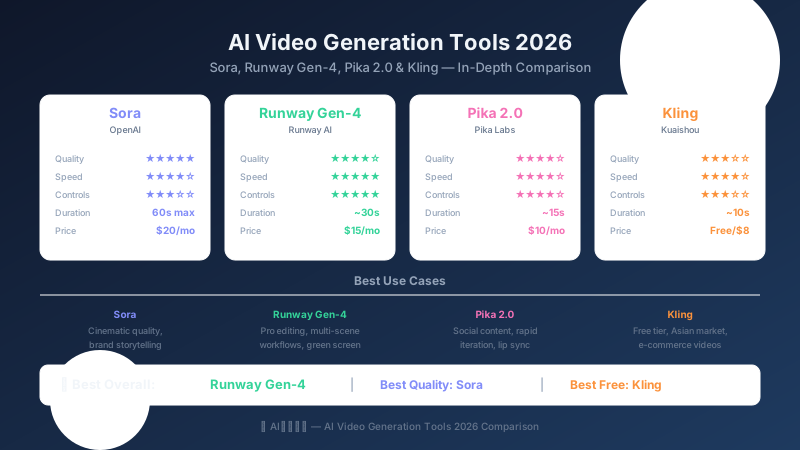
AI video generation has undergone a seismic shift in 2026. What was once a niche capability limited to short, often glitchy clips has matured into a full-fledged creative medium capable of producing studio-quality video content from text prompts, images, and even existing video footage. Four platforms have emerged as the definitive leaders in this space: OpenAI's Sora, Runway Gen-4, Pika 2.0, and Kuaishou's Kling. Each represents a distinct philosophy about how AI should create video, and each excels in different use cases.
This in-depth comparison evaluates these four AI video generation tools across the criteria that matter most to content creators, filmmakers, marketers, and businesses: video quality and realism, generation speed, creative controls and editing capabilities, maximum output duration, pricing, and real-world reliability. We generated over 500 video clips across diverse categories — cinematic scenes, product demonstrations, character animations, abstract visuals, and talking head sequences — to build a comprehensive picture of each tool's capabilities.
The State of AI Video in 2026
Before diving into individual tool reviews, it is worth understanding the technological landscape that makes these tools possible. AI video generation in 2026 is powered by a combination of diffusion transformer architectures, temporal attention mechanisms, and flow-matching techniques that enable unprecedented temporal coherence and visual quality. The key breakthroughs that distinguish 2026's tools from earlier generations include:
- Temporal consistency: Modern AI video models maintain character identity, object placement, and scene composition across extended sequences without the flickering or morphing artifacts that plagued earlier tools.
- Physical realism: Models now demonstrate genuine understanding of physics — gravity, fluid dynamics, lighting behavior, and material properties — resulting in videos that follow real-world physical rules.
- Multi-modal input: All four tools support text-to-video generation, while also accepting image-to-video, video-to-video style transfer, and in some cases, audio-driven lip sync and expression control.
- Extended duration: Maximum video lengths have expanded from the 4-second clips of 2024 to 60-second scenes (Sora) with coherent narratives, marking a dramatic leap in capability.
Understanding these foundations helps contextualize the strengths and weaknesses of each specific tool. No single platform leads across every dimension, and the best choice depends heavily on your specific creative needs and workflow preferences.
Sora (OpenAI) — The Cinematic Gold Standard
OpenAI's Sora, now in its second major iteration (Sora 2.0) since its public launch in early 2025, remains the undisputed leader in raw video quality and realism. Sora's videos consistently exhibit the most natural motion, the most accurate physics, and the highest degree of visual fidelity across diverse prompts. From cinematic nature documentaries to photorealistic urban scenes, Sora produces footage that is often indistinguishable from traditionally captured video.
Sora excels particularly at complex scenes with multiple characters, dynamic lighting, and intricate camera movements. Its understanding of cinematic language — shot composition, depth of field, camera tracking, and scene transitions — is unparalleled among AI video tools. The maximum output of 60 seconds per clip is the longest of any consumer AI video generator, and Sora can maintain coherent character identities and scene continuity across the full duration.
Key Strengths: Best-in-class video quality and photorealism, superior physics and motion coherence, longest maximum duration (60 seconds), excellent cinematic language understanding, strong at maintaining character identity across scenes, reliable performance with complex multi-subject prompts.
Key Weaknesses: Most expensive option at $20/month (ChatGPT Plus/Pro includes limited access), slowest generation speed (5-15 minutes per clip), limited direct creative controls (no frame-by-frame editing, no green screen, limited compositing), closed ecosystem with no API for custom workflows, occasional refusal of certain content types, less suitable for rapid prototyping or iterative experimentation.
Best For: Professional filmmakers and content creators producing high-production-value video, brand storytelling and advertising where quality is paramount, cinematic sequences that demand photorealism, and any application where video quality is the primary success metric and budget and time are secondary considerations.
Runway Gen-4 — The Video Editor's Swiss Army Knife
Runway Gen-4, the latest iteration from Runway AI (formerly RunwayML), takes a fundamentally different approach from Sora. Rather than focusing exclusively on raw generation quality, Runway Gen-4 is designed as a complete AI video production suite that combines text-to-video generation with professional-grade editing tools, green screen keying, motion tracking, inpainting, and multi-layer compositing. It is the closest thing to a traditional video editing environment enhanced by AI capabilities.
Gen-4's video quality is excellent, if slightly below Sora's peak photorealism. Where it truly shines is in creative control and editing flexibility. The platform offers frame-by-frame editing with AI inpainting, allowing creators to modify specific elements within a video after generation. The green screen (chroma key) feature works remarkably well, enabling seamless foreground-background separation for compositing. Gen-4 also supports video-to-video style transfer, where existing footage can be re-rendered in different visual styles while preserving the original motion and composition.
Key Strengths: Most comprehensive editing toolset of any AI video platform, excellent green screen and compositing capabilities, frame-by-frame AI inpainting for precise edits, fastest generation speed (30 seconds to 2 minutes per clip), video-to-video style transfer, strong motion tracking, supports layering and multi-track editing, good API for custom integrations.
Key Weaknesses: Video quality, while very good, does not match Sora's peak photorealism, maximum clip length around 30 seconds, steeper learning curve due to tool complexity, subscription cost of $15/month (Standard) to $35/month (Pro) with generation credits limiting quantity, interface can feel overwhelming for beginners who just want simple text-to-video generation.
Best For: Video editors and motion graphics artists who want AI as a production tool rather than a fully automated solution, commercial video production requiring precise control over individual elements, green screen and compositing workflows, iterative creative projects where editing flexibility matters more than one-shot quality.
Pika 2.0 — The Creator-First Platform
Pika 2.0, developed by Pika Labs, has carved out a strong position as the most accessible and creator-friendly AI video generation platform. Pika's design philosophy prioritizes ease of use, fast iteration, and social-media-ready output. Its interface is streamlined and intuitive, allowing creators to generate, modify, and export videos in minutes. Pika 2.0 introduced significant quality improvements over its predecessor, particularly in motion coherence and visual detail, bringing it much closer to the quality levels of Sora and Runway.
Pika's standout feature is its lip sync capability, which allows users to upload audio and have generated characters speak in sync with the audio track. This makes Pika uniquely well-suited for talking head videos, character dialogue, and educational content. Pika 2.0 also introduced advanced camera controls (pan, zoom, orbit, dolly), improved image-to-video generation, and a new "Pika Effects" library for applying stylized visual filters and transitions.
Key Strengths: Most user-friendly interface in the category, excellent lip sync and audio-driven video generation, fast generation speed (30 seconds to 1 minute per clip), good camera control options, strong social media output formats (vertical, square, 16:9), active community with regular feature updates, affordable pricing starting at $10/month, good for rapid prototyping and iteration.
Key Weaknesses: Maximum clip length limited to approximately 15 seconds, video quality good but not Sora-grade for complex scenes, fewer advanced editing tools than Runway Gen-4, limited multi-character scene handling, less reliable with abstract or surreal prompts, no frame-by-frame editing capability, API access limited compared to Runway.
Best For: Social media content creators who need fast, high-quality video generation, YouTubers and TikTok creators producing talking-head content with AI-generated visuals, rapid prototyping of video concepts before committing to higher-end production, educational content creators, and anyone who values ease of use and speed over maximum creative control.
Kling (Kuaishou) — The Democratizing Force
Kling, developed by Chinese tech giant Kuaishou, has emerged as the most significant democratizing force in AI video generation. Kling offers the most generous free tier of any major AI video platform — users can generate high-quality videos up to 10 seconds in length at no cost, with reasonable daily generation limits. The paid tier starts at just $8/month, making it by far the most affordable option for creators on a budget. What makes Kling remarkable is that this accessibility does not come at the expense of quality.
Kling's video generation quality has improved dramatically through 2025 and into 2026. While it does not match Sora's cinematic photorealism or Runway Gen-4's editing sophistication, Kling produces clean, coherent videos with good motion fidelity, accurate physics, and solid character rendering. It particularly excels at Asian-centric content — characters, environments, and cultural contexts that Western-developed tools sometimes render less convincingly. Kling also offers excellent text rendering in video, making it strong for advertising and promotional content.
Key Strengths: Most generous free tier — unlimited 10-second clips with daily usage limits, lowest paid pricing ($8/month), good overall video quality that has improved rapidly, excellent at Asian cultural contexts and aesthetics, strong text rendering in videos, fast generation speed, supports image-to-video and video style transfer, good for e-commerce and advertising content.
Key Weaknesses: Maximum clip length limited to approximately 10 seconds (compared to Sora's 60 seconds), fewer advanced creative controls than competitors, quality inconsistent on complex or abstract prompts, interface and documentation primarily in Chinese (English support improving but not complete), limited third-party integrations and API access, smaller community of Western creators for tutorials and workflows.
Best For: Budget-conscious creators who want AI video generation without subscription costs, e-commerce and advertising content production, Asian market-focused content creators, beginners exploring AI video generation for the first time, high-volume content production where cost per clip matters, and anyone who wants to experiment with AI video without financial commitment.
Head-to-Head Comparison Table
| Feature | Sora (OpenAI) | Runway Gen-4 | Pika 2.0 | Kling (Kuaishou) |
|---|---|---|---|---|
| Video Quality | ★★★★★ | ★★★★☆ | ★★★★☆ | ★★★☆☆ |
| Generation Speed | Slow (5-15 min) | Fast (30s-2 min) | Fast (30s-1 min) | Fast (30s-2 min) |
| Max Clip Duration | 60 seconds | ~30 seconds | ~15 seconds | ~10 seconds |
| Creative Controls | ⚠️ Limited | ✅ Extensive | ✅ Good | ⚠️ Basic |
| Green Screen / Keying | ❌ | ✅ Excellent | ❌ | ❌ |
| Lip Sync / Audio Drive | ❌ | ⚠️ Basic | ✅ Best | ❌ |
| Frame-by-Frame Edit | ❌ | ✅ Inpainting | ❌ | ❌ |
| Image-to-Video | ✅ | ✅ | ✅ | ✅ |
| Video-to-Video | ⚠️ Limited | ✅ Good | ⚠️ Basic | ✅ Good |
| Free Tier | ❌ (Paid only) | ⚠️ Limited | ⚠️ Basic | ✅ Generous |
| Price (Monthly) | $20+ | $15-$35 | $10+ | Free / $8 |
| Best For | Cinematic quality | Pro editing | Social content | Budget/volume |
Use Case Recommendations
With four strong contenders, choosing the right AI video generation tool depends heavily on your specific use case. Here is our guidance for common scenarios:
Brand Storytelling and Advertising
For high-production-value brand content where quality is non-negotiable, Sora is the clear choice. Its cinematic quality and 60-second clip duration make it ideal for narrative-driven advertising, product launches, and brand films. If you need to iterate on edits or composite elements (text overlays, product shots), pair Sora's output with Runway Gen-4 for post-production.
Social Media Content Creation
Pika 2.0 is the best fit for social media creators who need to produce content quickly and consistently. Its fast generation speed, lip sync capabilities for talking-head content, and social-optimized output formats make it ideal for TikTok, Instagram Reels, and YouTube Shorts. The $10/month price point is easily justifiable for creators monetizing their content.
Commercial Video Production
Runway Gen-4 is the tool of choice for professional video editors and commercial production studios. Its comprehensive editing toolset — green screen, inpainting, motion tracking, multi-layer compositing — allows for the kind of precise control that professional work demands. The learning curve is worth the investment for teams producing high volumes of commercial video content.
E-Commerce and Advertising Content
Kling offers the best value for e-commerce businesses producing product videos, promotional clips, and advertising content at scale. Its strong text rendering makes it particularly effective for ads with visual text overlays, and the generous free tier allows businesses to test and iterate before committing to a paid plan. The $8/month subscription is the lowest cost of entry for commercial AI video generation.
Educational and Explainer Content
Pika 2.0 with its lip sync capability is the strongest option for educational content featuring talking heads or animated characters explaining concepts. For more visually complex explainer videos, Runway Gen-4 provides the compositing tools needed to combine AI-generated footage with traditional graphics and text overlays.
The Verdict: Which AI Video Tool Should You Choose in 2026?
After extensive testing across all four platforms, our overall assessment is clear: there is no universal "best" AI video generation tool in 2026, but there is a clear best tool for each specific use case.
Sora remains the gold standard for video quality and is the best choice when production value is the primary concern. If you are creating content where every frame needs to look cinematic, Sora's $20/month is money well spent. However, its slow generation speed and limited creative controls make it less suitable for iterative or high-volume work.
Runway Gen-4 is the most versatile and professional-grade platform, earning it our pick as the best overall AI video generation tool for 2026 for most professional users. It strikes the best balance between quality, control, speed, and editing capability. If you can only invest in one AI video platform, Runway Gen-4 offers the most comprehensive feature set.
Pika 2.0 is the best choice for creators who prioritize speed, ease of use, and social-media-optimized output. Its lip sync capability is genuinely unique and valuable for talking-head content. For individual creators building an audience on social platforms, Pika 2.0 offers the best return on investment.
Kling is the democratizing force that makes AI video generation accessible to everyone. Its generous free tier and $8/month premium plan mean that budget is never a barrier to entry. For beginners, students, and high-volume content producers, Kling is an excellent starting point that continues to improve at a rapid pace.
Our recommendation for most creators and businesses is to start with Kling's free tier to learn the fundamentals of AI video generation, then graduate to Pika 2.0 or Runway Gen-4 as your needs grow. For production environments where quality is paramount, add Sora as a premium option for your most important projects. This tiered approach ensures you match tool capability to content value without overspending.